![RD Sharma Class 9 Solutions: Complete Guide [2026]](https://static.kopykitab.com/blog/wp-content/uploads/2021/09/RD-Sharma-Class-9-Solutions-Chapter-11-VSAQS-1.jpg)

Read more: RD Sharma Class 9 — Complete Guide
RD Sharma Class 9 Solutions Chapter 11 MCQs: MCQ type questions ko solve karna kuch students ke liye tricky ho sakta hai. But tension mat lo kyunki humne RD Sharma Class 9 Solutions Chapter 11 MCQs aapke liye tayyar kiye hain. Saare MCQs easy aur understandable manner mein solve kiye gaye hain. Aap dusre exercises ke solutions RD Sharma Class 9 Solutions Maths mein dekh sakte hain. RD Sharma Class 9 Solutions Chapter 11 MCQs ke baare mein aur jaanne ke liye, pura blog padhiye.
Explore Study Materials
Get comprehensive study materials, practice tests, and expert guides for your exam preparation.
Access answers of RD Sharma Class 9 Solutions Chapter 11 MCQs
Yahan par hum aapko Chapter 11 ke saare MCQ questions ke detailed solutions provide kar rahe hain. Ye questions coordinate geometry ke basic concepts par based hain jo ki Class 9 maths ka ek important part hai.
Mark the correct alternative in each of the following:
Question 1.
If all the three angles of a triangle are equal, then each one of them is equal to
(a) 90°
(b) 45°
(c) 60°
(d) 30°
Solution:
∵ Sum of three angles of a triangle = 180°
∴ Each angle = 180∘3 = 60° (c)
Question 2.
If two acute angles of a right triangle are equal, then each acute is equal to
(a) 30°
(b) 45°
(c) 60°
(d) 90°
Solution:
In a right triangle, one angle = 90°
∴ Sum of other two acute angles = 180° – 90° = 90°
∵ Both angles are equal
∴ Each angle will be = 90∘2 = 45° (b)
Question 3.
An exterior angle of a triangle is equal to 100° and two interior opposite angles are equal. Each of these angles is equal to
(a) 75°
(b) 80°
(c) 40°
(d) 50°
Solution:
In a triangle, exterior angles is equal to the sum of its interior opposite angles
∴ Sum of interior opposite angles = 100°
∵ Both angles are equal
∴ Each angle will be = 100∘2 = 50° (d)
Question 4.
If one angle of a triangle is equal to the sum of the other two angles, then the triangle is
(a) an isosceles triangle
(b) an obtuse triangle
(c) an equilateral triangle
(d) a right triangle
Solution:
Let ∠A, ∠B, ∠C be the angles of a ∆ABC and let ∠A = ∠B + ∠C RD-Sharma-Class-9-Solutions-Chapter-11-Co-ordinate-Geometry-MCQS-Q4.1.png” alt=”RD Sharma Class 9 Solutions Chapter 11 Co-ordinate Geometry MCQS Q4.1″ width=”254″ height=”176″ />
But ∠A + ∠B + ∠C = 180°
( Sum of angles of a triangle)
∴ ∠A + ∠A = 180° ⇒ 2∠A = 180°
⇒ ∠A = 180∘2 = 90°
∴ ∆ is a right triangle (d)
Question 5.
Side BC of a triangle ABC has been produced to a point D such that ∠ACD = 120°. If ∠B = 12∠A, then ∠A is equal to
(a) 80°
(b) 75°
(c) 60°
(d) 90°
Solution:
Side BC of ∆ABC is produced to D, thenRD-Sharma-Class-9-Solutions-Chapter-11-Co-ordinate-Geometry-MCQS-Q5.1.png” sizes=”(max-width: 305px) 100vw, 305px” srcset=”https://www.learninsta.com/wp-content/uploads/2018/06/RD-Sharma-Class-9-Solutions-Chapter-11-Co-ordinate-Geometry-MCQS-Q5.1.png 305w, https://www.learninsta.com/wp-content/uploads/2018/06/RD-Sharma-Class-9-Solutions-Chapter-11-Co-ordinate-Geometry-MCQS-Q5.1-300×188.png 300w” alt=”RD Sharma Class 9 Solutions Chapter 11 Co-ordinate Geometry MCQS Q5.1″ width=”305″ height=”191″ />
Ext. ∠ACB = ∠A + ∠B
(Exterior angle of a triangle is equal to the sum of its interior opposite angles)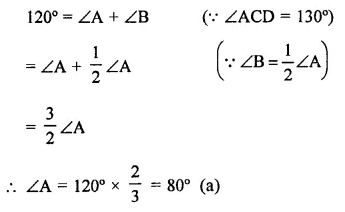
Question 6.
In ∆ABC, ∠B = ∠C and ray AX bisects the exterior angle ∠DAC. If ∠DAX = 70°, then ∠ACB =
(a) 35°
(b) 90°
(c) 70°
(d) 55°
Solution:
In ∆ABC, ∠B = ∠C
AX is the bisector of ext. ∠CAD
∠DAX = 70°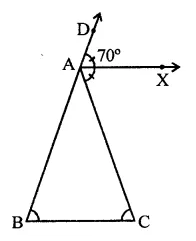
∴ ∠DAC = 70° x 2 = 140°
But Ext. ∠DAC = ∠B + ∠C
= ∠C + ∠C (∵ ∠B = ∠C)
= 2∠C
∴ 2∠C = 140° ⇒ ∠C = 140∘2 = 70°
∴ ∠ACB = 70° (c)
Question 7.
In a triangle, an exterior angle at a vertex is 95° and its one of the interior opposite angle is 55°, then the measure of the other interior angle is
(a) 55°
(b) 85°
(c) 40°
(d) 9.0°
Solution:
In ∆ABC, BA is produced to D such that ∠CAD = 95°
and let ∠C = 55° and ∠B = x°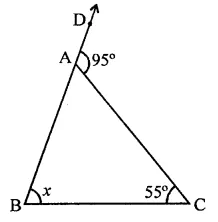
∵ Exterior angle of a triangle is equal to the sum of its opposite interior angle
∴ ∠CAD = ∠B + ∠C ⇒ 95° = x + 55°
⇒ x = 95° – 55° = 40°
∴ Other interior angle = 40° (c)
Question 8.
If the sides of a triangle are produced in order, then the sum of the three exterior angles so formed is
(a) 90°
(b) 180°
(c) 270°
(d) 360°
Solution:
In ∆ABC, sides AB, BC and CA are produced in order, then exterior ∠FAB, ∠DBC and ∠ACE are formed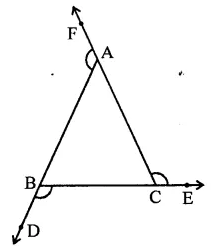
We know an exterior angles of a triangle is equal to the sum of its interior opposite angles
∴ ∠FAB = ∠B + ∠C
∠DBC = ∠C + ∠A and
∠ACE = ∠A + ∠B Adding we get,
∠FAB + ∠DBC + ∠ACE = ∠B + ∠C + ∠C + ∠A + ∠A + ∠B
= 2(∠A + ∠B + ∠C)
= 2 x 180° (Sum of angles of a triangle)
= 360° (d)
Question 9.
In ∆ABC, if ∠A = 100°, AD bisects ∠A and AD⊥ BC. Then, ∠B =
(a) 50°
(b) 90°
(c) 40°
(d) 100°
Solution:
In ∆ABC, ∠A = 100°
AD is bisector of ∠A and AD ⊥ BC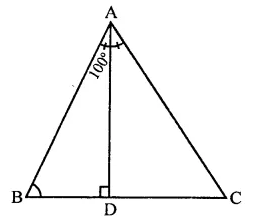
Now, ∠BAD = 100∘2 = 50°
In ∆ABD,
∠BAD + ∠B + ∠D= 180°
(Sum of angles of a triangle)
⇒ ∠50° + ∠B + 90° = 180°
∠B + 140° = 180°
⇒ ∠B = 180° – 140° ∠B = 40° (c)
Question 10.
An exterior angle of a triangle is 108° and its interior opposite angles are in the ratio 4:5. The angles of the triangle are
(a) 48°, 60°, 72°
(b) 50°, 60°, 70°
(c) 52°, 56°, 72°
(d) 42°, 60°, 76°
Solution:
In ∆ABC, BC is produced to D and ∠ACD = 108°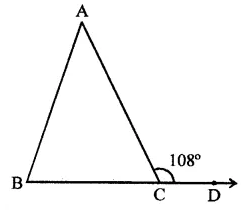
Ratio in ∠A : ∠B = 4:5
∵ Exterior angle of a triangle is equal to the sum of its opposite interior angles
∴ ∠ACD = ∠A + ∠B = 108°
Ratio in ∠A : ∠B = 4:5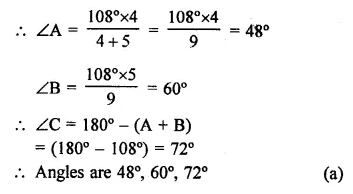
Question 11.
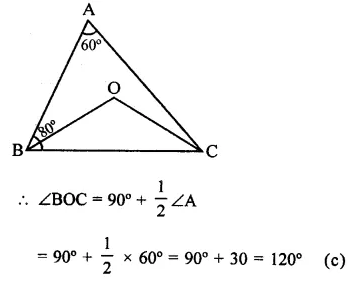
In a ∆ABC, if ∠A = 60°, ∠B = 80° and the bisectors of ∠B and ∠C meet at O, then ∠BOC =
(a) 60°
(b) 120°
(c) 150°
(d) 30°
Solution:
In ∆ABC, ∠A = 60°, ∠B = 80°
∴ ∠C = 180° – (∠A + ∠B)
= 180° – (60° + 80°)
= 180° – 140° = 40°
Bisectors of ∠B and ∠C meet at O
Question 12.
Line segments AB and CD intersect at O such that AC || DB. If ∠CAB = 45° and ∠CDB = 55°, then ∠BOD =
(a) 100°
(b) 80°
(c) 90°
(d) 135°
Solution:
In the figure,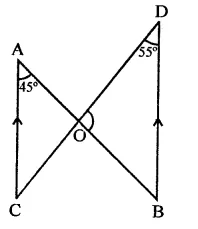
AB and CD intersect at O
and AC || DB, ∠CAB = 45°
and ∠CDB = 55°
∵ AC || DB
∴ ∠CAB = ∠ABD (Alternate angles)
In ∆OBD,
∠BOD = 180° – (∠CDB + ∠ABD)
= 180° – (55° + 45°)
= 180° – 100° = 80° (b)
Question 13.
In the figure, if EC || AB, ∠ECD = 70° and ∠BDO = 20°, then ∠OBD is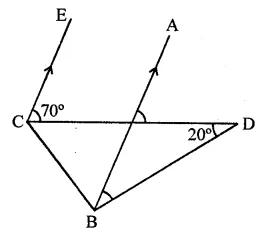
(a) 20°
(b) 50°
(c) 60°
(d) 70°
Solution:
In the figure, EC || AB
∠ECD = 70°, ∠BDO = 20°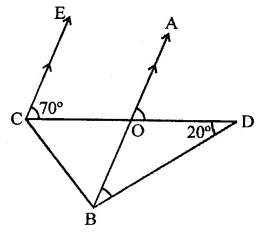
∵ EC || AB
∠AOD = ∠ECD (Corresponding angles)
⇒ ∠AOD = 70°
In ∆OBD,
Ext. ∠AOD = ∠OBD + ∠BDO
70° = ∠OBD + 20°
⇒ ∠OBD = 70° – 20° = 50° (b)
Question 14.
In the figure, x + y =
(a) 270
(b) 230
(c) 210
(d) 190°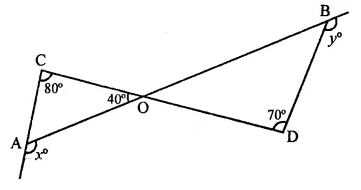
Solution:
In the figure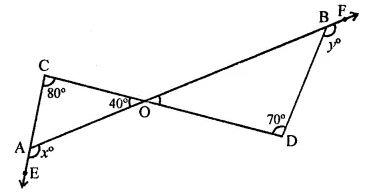
Ext. ∠OAE = ∠AOC + ∠ACO
⇒ x = 40° + 80° = 120°
Similarly,
Ext. ∠DBF = ∠ODB + ∠DOB
y = 70° + ∠DOB
[(∵ ∠AOC = ∠DOB) (vertically opp. angles)]
= 70° + 40° = 110°
∴ x+y= 120°+ 110° = 230° (b)
Question 15.
If the measures of angles of a triangle are in the ratio of 3 : 4 : 5, what is the measure of the smallest angle of the triangle?
(a) 25°
(b) 30°
(c) 45°
(d) 60°
Solution:
Ratio in the measures of the triangle =3:4:5
Sum of angles of a triangle = 180°
Let angles be 3x, 4x, 5x
Sum of angles = 3x + 4x + 5x = 12x
∴ Smallest angle = 180x3x12x = 45° (c)
Question 16.
In the figure, if AB ⊥ BC, then x =
(a) 18
(b) 22
(c) 25
(d) 32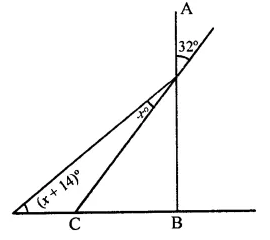
Solution:
In the figure, AB ⊥ BC
∠AGF = 32°
∴ ∠CGB = ∠AGF (Vertically opposite angles)
= 32°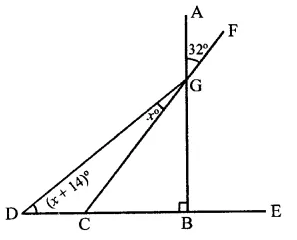
In ∆GCB, ∠B = 90°
∴ ∠CGB + ∠GCB = 90°
⇒ 32° + ∠GCB = 90°
⇒ ∠GCB = 90° – 32° = 58°
Now in ∆GDC,
Ext. ∠GCB = ∠CDG + ∠DGC
⇒ 58° = x + 14° + x
⇒ 2x + 14° = 58°
⇒ 2x = 58 – 14° = 44
⇒ x = 442 = 22°
∴ x = 22° (b)
Question 17.
In the figure, what is ∠ in terms of x and y?
(a) x + y + 180
(b) x + y – 180
(c) 180° -(x+y)
(d) x+y + 360°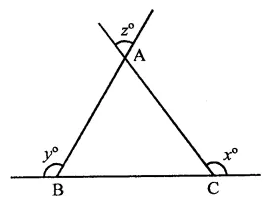
Solution:
In the figure, BC is produced both sides CA and BA are also produced
In ∆ABC,
∠B = 180° -y
and ∠C 180° – x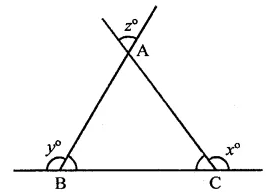
∴ z = ∠A = 180° – (B + C)
= 180° – (180 – y + 180 -x)
= 180° – (360° – x – y)
= 180° – 360° + x + y = x + y – 180° (b)
Question 18.
In the figure, for which value of x is l1 || l2?
(a) 37
(b) 43
(c) 45
(d) 47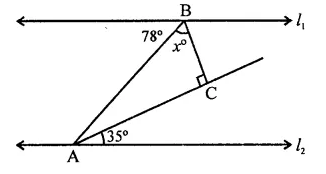
Solution:
In the figure, l1 || l2
∴ ∠EBA = ∠BAH (Alternate angles)
∴ ∠BAH = 78°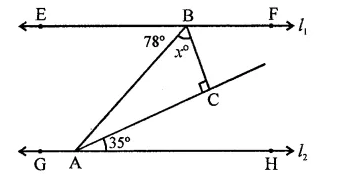
⇒ ∠BAC + ∠CAH = 78°
⇒ ∠BAC + 35° = 78°
⇒ ∠BAC = 78° – 35° = 43°
In ∆ABC, ∠C = 90°
∴ ∠ABC + ∠BAC = 90°
⇒ x + 43° = 90° ⇒ x = 90° – 43°
∴ x = 47° (d)
Question 19.
In the figure, what is y in terms of x?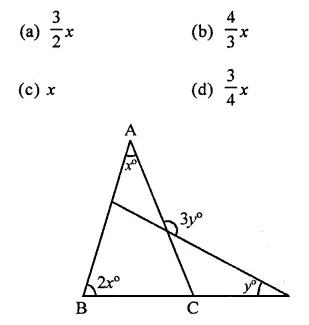
Solution:
In ∆ABC,
∠ACB = 180° – (x + 2x)
= 180° – 3x …(i)
and in ∆BDG,
∠BED = 180° – (2x + y) …(ii)
∠EGC = ∠AGD (Vertically opposite angles)
= 3y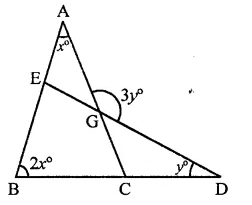
In quad. BCGE,
∠B + ∠ACB + ∠CGE + ∠BED = 360° (Sum of angles of a quadrilateral)
⇒ 2x+ 180° – 3x + 3y + 180°- 2x-y = 360°
⇒ -3x + 2y = 0
⇒ 3x = 2y ⇒ y = 32x (a)
Question 20.
In the figure, what is the value of x?
(a) 35
(b) 45
(c) 50
(d) 60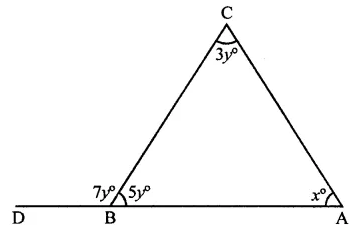
Solution:
In the figure, side AB is produced to D
∴ ∠CBA + ∠CBD = 180° (Linear pair)
⇒ 7y + 5y = 180°
⇒ 12y = 180°
⇒ y = 18012 = 15
and Ext. ∠CBD = ∠A + ∠C
⇒ 7y = 3y + x
⇒ 7y -3y = x
⇒ 4y = x
∴ x = 4 x 15 = 60 (d)
Question 21.
In the figure, the value of x is
(a) 65°
(b) 80°
(c) 95°
(d) 120°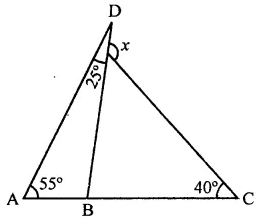
Solution:
In the figure, ∠A = 55°, ∠D = 25° and ∠C = 40°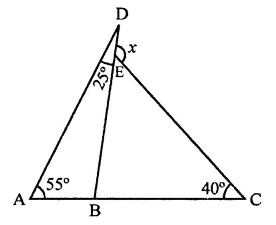
Now in ∆ABD,
Ext. ∠DBC = ∠A + ∠D
= 55° + 25° = 80°
Similarly, in ∆BCE,
Ext. ∠DEC = ∠EBC + ∠ECB
= 80° + 40° = 120° (d)
Question 22.
In the figure, if BP || CQ and AC = BC, then the measure of x is
(a) 20°
(b) 25°
(c) 30°
(d) 35°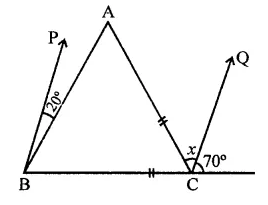
Solution:
In the figure, AC = BC, BP || CQ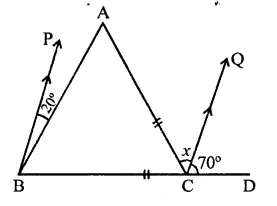
∵ BP || CQ
∴ ∠PBC – ∠QCD
⇒ 20° + ∠ABC = 70°
⇒ ∠ABC = 70° – 20° = 50°
∵ BC = AC
∴ ∠ACB = ∠ABC (Angles opposite to equal sides)
= 50°
Now in ∆ABC,
Ext. ∠ACD = ∠B + ∠A
⇒ x + 70° = 50° + 50°
⇒ x + 70° = 100°
∴ x = 100° – 70° = 30° (c)
Question 23.
In the figure, AB and CD are parallel lines and transversal EF intersects them at P and Q respectively. If ∠APR = 25°, ∠RQC = 30° and ∠CQF = 65°, then
(a) x = 55°, y = 40°
(b) x = 50°, y = 45°
(c) x = 60°, y = 35°
(d) x = 35°, y = 60°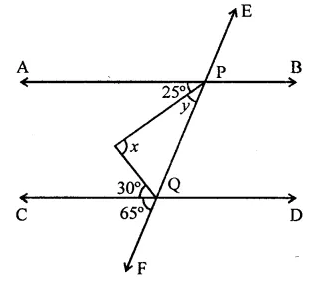
Solution:
In the figure,
∵ AB || CD, EF intersects them at P and Q respectively,
∠APR = 25°, ∠RQC = 30°, ∠CQF = 65°
∵ AB || CD
∴ ∠APQ = ∠CQF (Corresponding anlges)
⇒ y + 25° = 65°
⇒ y = 65° – 25° = 40°
and APQ + PQC = 180° (Co-interior angles)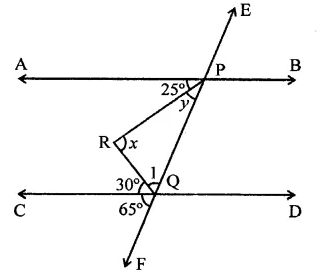
y + 25° + ∠1 +30°= 180°
40° + 25° + ∠1 + 30° = 180°
⇒ ∠1 + 95° = 180°
∴ ∠1 = 180° – 95° = 85°
Now, ∆PQR,
∠RPQ + ∠PQR + ∠PRQ = 180° (Sum of angles of a triangle)
⇒ 40° + x + 85° = 180°
⇒ 125° + x = 180°
⇒ x = 180° – 125° = 55°
∴ x = 55°, y = 40° (a)
Question 24.
The base BC of triangle ABC is produced both ways and the measure of exterior angles formed are 94° and 126°. Then, ∠BAC = ?
(a) 94°
(b) 54°
(c) 40°
(d) 44°
Solution:
In ∆ABC, base BC is produced both ways and ∠ACD = 94°, ∠ABE = 126°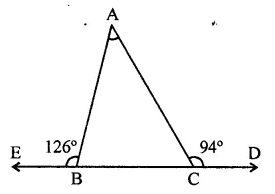
Ext. ∠ACD = ∠BAC + ∠ABC
⇒ 94° = ∠BAC + ∠ABC
Similarly, ∠ABE = ∠BAC + ∠ACB
⇒ 126° = ∠BAC + ∠ACB
Adding,
94° + 126° = ∠BAC + ∠ABC + ∠ACB + ∠BAC
220° = 180° + ∠BAC
∴ ∠BAC = 220° -180° = 40° (c)
Question 25.
If the bisectors of the acute angles of a right triangle meet at O, then the angle at O between the two bisectors is
(a) 45°
(b) 95°
(c) 135°
(d) 90°
Solution:
In right ∆ABC, ∠A = 90°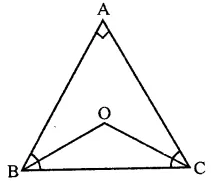
Bisectors of ∠B and ∠C meet at O, then 1
∠BOC = 90° +