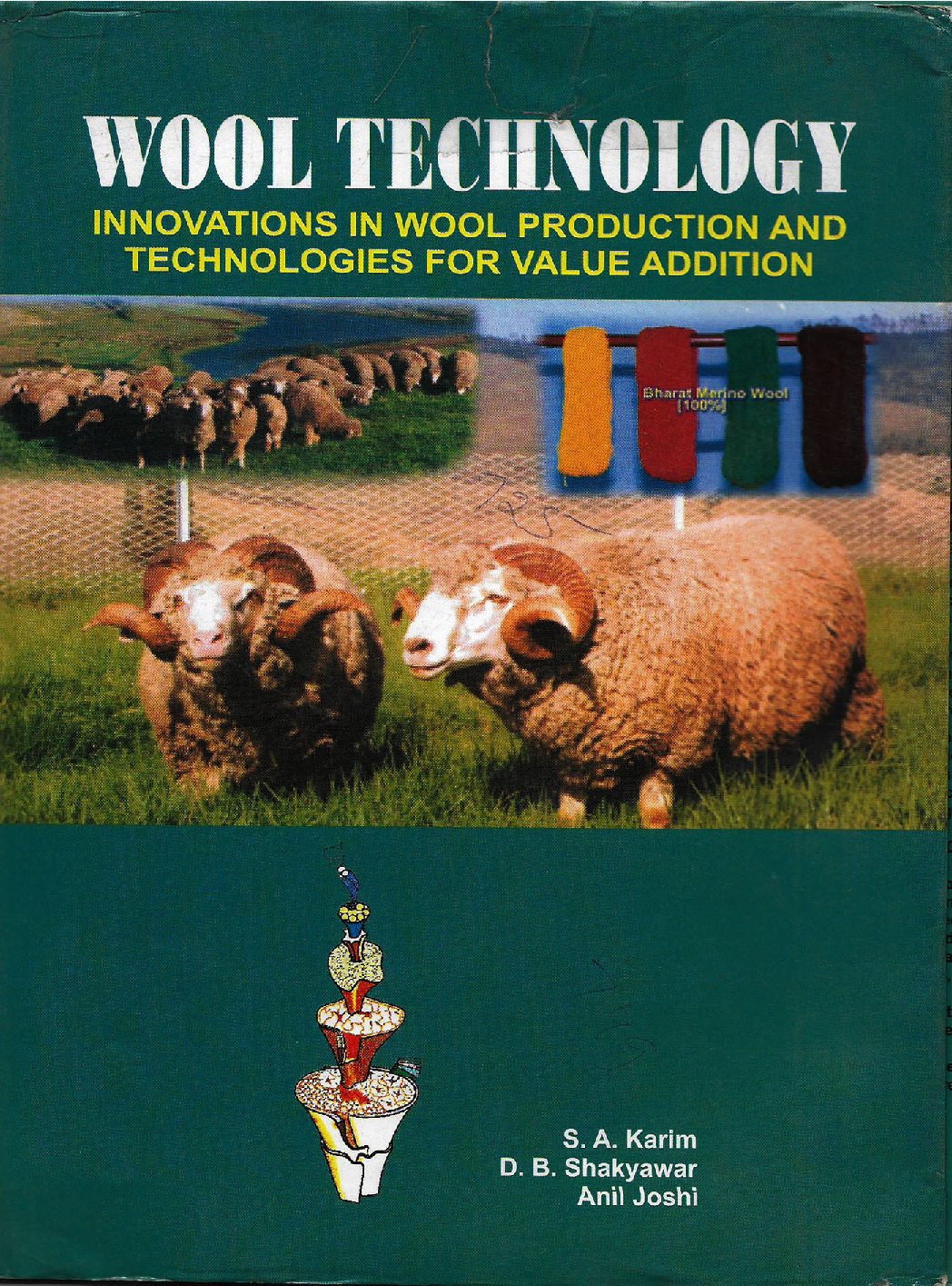
Wool Technology

By Karim SA more
4841 Views
₹2,980.00

Add to Wish Lists

Save extra with 2 Offers

Get Rs.50 Instant Cashback on the purchase of Rs.400 or above

NEW35,

Get Flat 35% Off on your First Order

Product Specifications

Publisher Agrotech Publications
ISBN 9788183211529
Author: Karim SA
Number of Pages 417
Available
Available in all digital devices
Request for Books
  • Snapshot
  • About the book

About this eBook

Preface Agriculture occupies a predominant position in Indian economy. The contribution of livestock sector has been substantial and is linked with the rural economy of our country in enhancing income, nutritional security, employment and reducing the incidence of poverty. India is endowed with wide diversity of sheep genetic resources. It has about 60 million sheep ranking third in the world sheep population. Out of about 900 breeds listed in the world, 42 breeds of sheep are found in India. Sheep constitute an important small ruminant livestock of millions of small and landless farmers of the country for their livelihood. A major proportion of sheep population thrives well in arid and semi arid areas of western region and southern peninsular region of the country. The average wool production per sheep is only 0.9 kg as against the world average of 2.4 kg. The country produces about 45 m kg of raw wool, out of that 85 is of carpet grade, 10 is of coarse grade and 5 is of apparel grade. It is not enough to meet the requirement of woollen industry. The low wool production of indigenous sheep breeds is a stumbling block for converting the immense bio-resources into more remunerative economic wealth on sustainable basis to cope up with the rising demand of end users. Hence, substantial quantity of raw wool is being imported every year to meet the requirement of the industry. Wool as a natural fibre of animal origin has attracted the attention of mankind since the dawn of civilization. As the raw material it has been readily available since the widespread domestication of sheep. Wool is used largely for apparel, with coarser types used for bedding, upholstery and carpets. In recent years annual wool production has been around 2.2 million tonnes of which Australia produces around 25 percent while China, New Zealand, Iran, Argentina, UK and India each produce more than 50,000 tonnes. International export of greasy plus scoured wool amount to around 8,00,000 tonnes annually and much of this is imported to processing countries for manufacture and subsequent re-export. Realizing the global importance of natural fibres in the present context, the United Nations passed a resolution on January 23, 2007 to observe 2009 as the International Year of Natural Fibres. The decision is likely to contribute in further developing the efficiency and sustainability of woollen based industries in terms of their value addition and marketing. Central Sheep and Wool Research Institute is a pioneer research institution on sheep. The institute has developed several technologies to utilize indigenous wool for value addition. It is an appropriate time for the institute to organize a Winter School on "Innovations in Wool Production and Technologies fo r Value Addition from December 4 to 24, 2008 to give emphasis on recent research and development activities on production and value addition of wool and speciality hair fibres. On this occasion a book on lecture notes delivered by eminent scientists and technocrats specially Prof. S M Ishtiqaue and Prof. B K Behera from NT Delhi, Dr K K Goswami, Director, Indian Institute of Carpet Technology, Bhadohi and Er Muntizer Ahmed, Ex-Principal Scientist from CIRCOT, Mumbai, is being published to extend knowledge and information to the participants and also acting as a scientific repository of information for students and teachers engaged in research and development activities in the focal theme of the winter school. Editors
About the book Wool obtained from sheep possesses unique characteristics of softness, warmthness and provides excellent hand value. It has many versatile uses in apparel, floor coverings and furnishings. The contribution of wool in Indian textiles is relatively less as compared to other natural and synthetic fibers. However, woollen textiles are important as they are exported widely and provide employment in both the rural and organized sectors, at relatively low capital cost in some specific areas of utilization. The Indian Woollen Industry is well recognized, particularly in the field of carpet export. The major production of wool in India is of carpet quality. In apparel sector the industry depends mostly on imported fine wool. Non-woven woollen felt has emerged as a newer industrial application. These applications add value to the wool by more than three to five folds. The present book is an outcome of series of lectures were delivered by experts

Amazing features to make your reading easier
Offline Reading
KopyKitab eReader lets you read your ebooks offline anytime and anywhere you want to. Enjoy the flexibility of reading on the go without having to carry your books everywhere.
Highlight Important Points
Preparing for Exams? KopyKitab eReader can be your perfect companion. Highlight important definitions, formulas etc. and read them anytime without having to flip around 100 of pages and bookmarks.
Print Your Notes
Even better now you can make a booklet of all the important notes/highlights that you have made and carry them around to school/college etc. Your revision list is now automated.
Any Device Any Time
Read on a bigger screen or read using your mobile phone while travelling in the Metro we got you covered. Install our android app or desktop app and read Anytime,Anywhere.
Measure Your Progress
Track the amount of time you have spent on reading your ebooks, take online test preprations and see your results KopyKitab unlocks a whole bunch of features that is tailor made to make your reach your examination goals.
x