gene order, codon usage bias, and GC-content to determine what mechanisms could have produced the great variety of genomes that exist today .Duplications play a major role in shaping the genome. Duplications may range from extension of short tandem repeats, to duplication of a cluster of genes, and all the way to duplications of entire chromosomes or even entire genomes. Such duplications are probably fundamental to the creation of genetic novelty. Horizontal gene transfer is invoked to explain how there is often extreme similarity between small portions of the genomes of two organisms that are otherwise very distantly related. Horizontal gene transfer seems to be common among many microbes. Also, eukaryotic cells seem to have experienced a transfer of some genetic material from their chloroplast and mitochondrial genomes to their nuclear chromosomes.
Genetic material of plant cell 1.Nuclear genome. 2.Mitochondrial genome. 3.Chloroplast genome. 1.Nuclear genome
Chromosomes and chromatin.
Histones and chromatin.
5 major classes of histone proteins.
Nucleosomes and nucleosome core particle.
Structurial hierarchy of chromosomes.
Gene loci are non-randomly organized. This applies to their linear arrangements on chromosomes, as well as to their spatial organization in the nucleus. Recent chromosomewide and genome-wide studies give insights into which loci interact at the nuclear periphery with the lamina or nuclear pores. The functional role of peripheral localization in gene silencing is still unclear. Recent studies suggest that it regulates the silencing of some but not all loci. Active loci are enriched in the nuclear interior, and here they frequently associate with splicing speckles. Juxtaposition of chromosomal loci at such nuclear domains can falsely imply functional interactions. True functional interactions between chromosomal loci do, however, appear to regulate gene activity in many ways. 2. Mitochondrial genome Circular,simple, double stranded similar to prokaryotes. Contains genes codes for Oxidative phosphorylation, rRNA, tRNA.
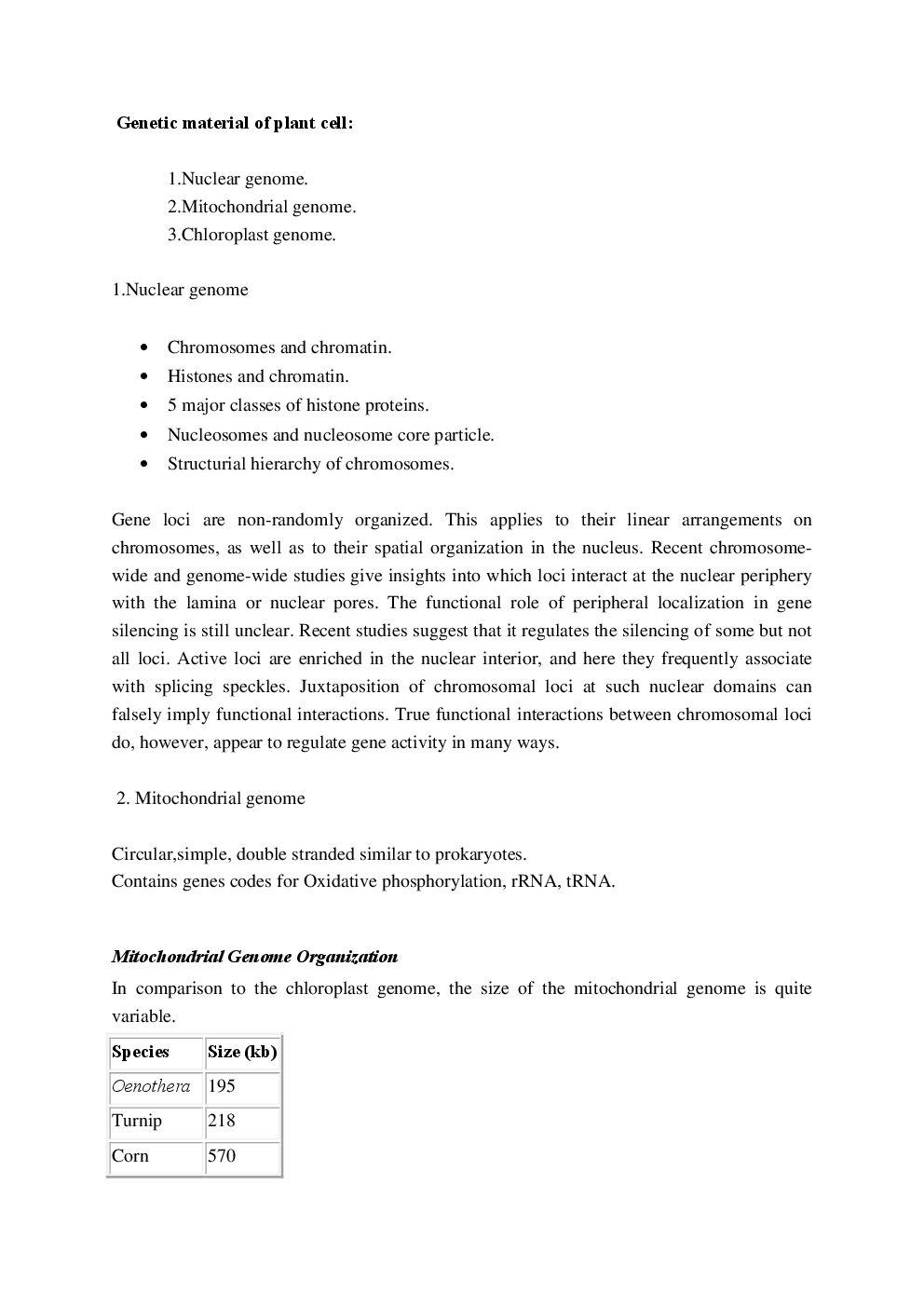
Mitochondrial Genome Organization In comparison to the chloroplast genome, the size of the mitochondrial genome is quite