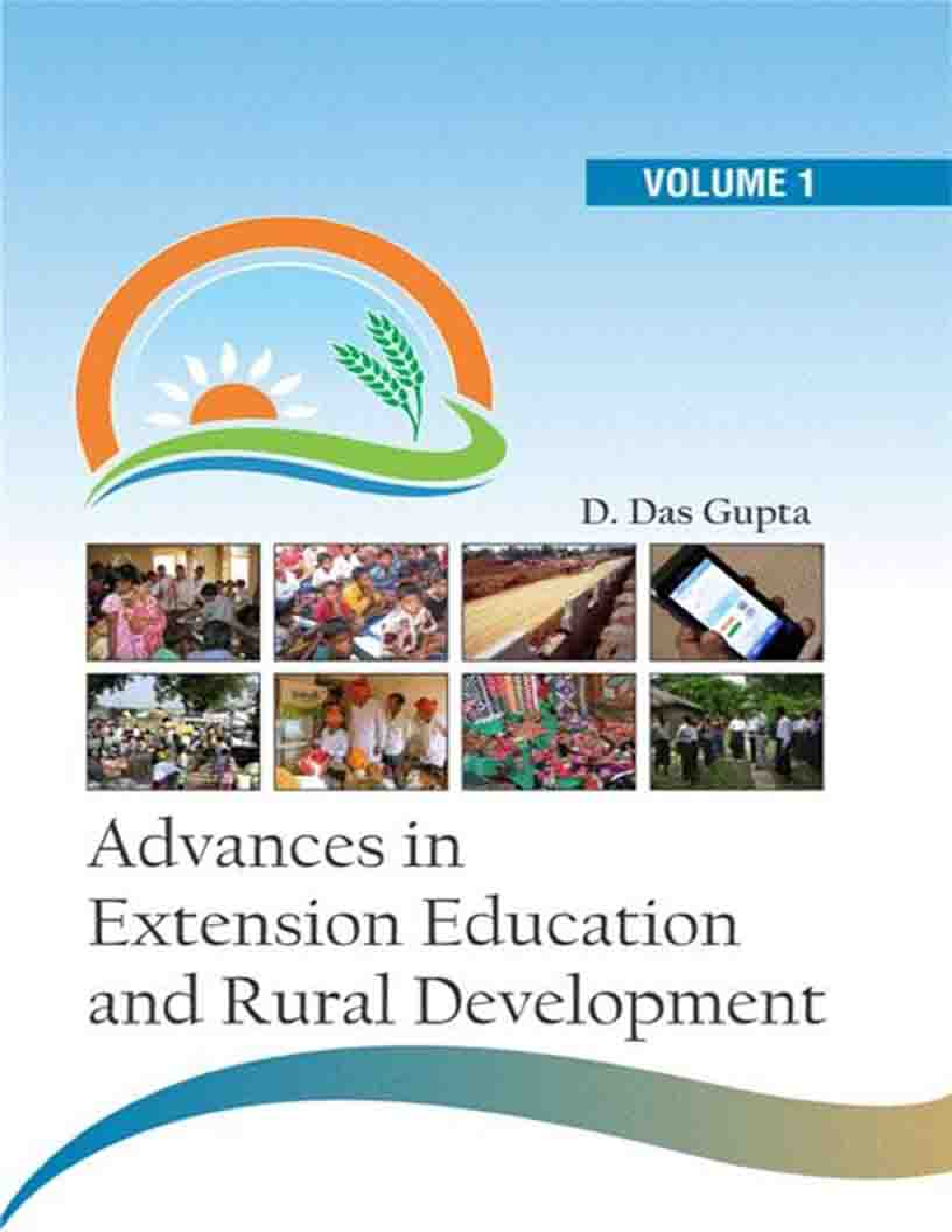
Advances in Extension Education and Rural Development Volume 1

By Gupta D Das more
4338 Views
₹2,500.00

Add to Wish Lists

Save extra with 2 Offers

Get Rs.50 Instant Cashback on the purchase of Rs.400 or above

NEW35,

Get Flat 35% Off on your First Order

Product Specifications

Publisher Agrobios Publications
ISBN 9788177545296
Author: Gupta D Das
Number of Pages 398
Available
Available in all digital devices
Request for Books
  • Snapshot
  • About the book

About this eBook

PREFACE
1
The Independent India adopted a system of parliamentary democracy. It has democratically elected governments for the last 65 years. By far it is the largest democracy in the world. In India the share of agriculture excluding forestry and fishery in the total output has been declining rapidly. Transforming its primarily rural agrarian economy into a modern one is the ultimate challenge India faces. Actually, the vast majority of the Indian population continues to live in rural areas and rely on farming as the principal source of income. Looking at the issue from a slightly different angle, even outside of agriculture, approximately 90 percent of the workforce remains employed in the informal, unorganized sector. Employment in the organized sector either has not grown or has grown very little. Telecommunications is probably the most important success story of reforms in India. It is assumed that the high rate of growth in the services sector in recent years is largely due to the success attained in this important sector. Significant success has been achieved in two areas. One is national highway construction and other is domestic civil aviation. With respect to national highways, it has been the near completion of the Golden Quadrilateral Project involving widening the highways connecting the metropolitan cities of Delhi, Mumbai, Chennai and Kolkata to four or more lanes. An acceleration of Indian growth in the GDP, foreign trade and foreign investment has been noticed in the last few decades. At the aggregate level, the growth rate during 19882006 was 6.3 percent, compared with 4.8 percent during 1981-1988. During the period from 2003-04 to 2005-07, the country's GDP as factor cost grew at the impressive rate of 8.6 percent. According to the available evidence, rural inequality has remained unchanged or has declined marginally while urban inequality has at worst increased by 10 to 12 percent, depending on the index and methodology used. Evidence on the rise in the urban-rural inequality and regional inequality is more compelling. India's past experience shows that preoccupation with inequality can lead to the adoption of policies that are anti-growth and anti-poor. From the future policy perspectives, it is important to remember that direct measures that aim to address must concentrate more heavily on the lagging states. Beyond such bias in favour of the lagging states, it will be prudent for the government to embark upon activist policies to correct regional inequality. It can be concluded that a macroeconomic crisis in the near future is unlikely. Nevertheless, the need for continued reduction in the fiscal deficit can hardly be overemphasized. In recent years, India has made some progress in this direction. However, there is no reason for complacency. A stable macroeconomic environment is a crucial condition for sustainable growth.
Rapid growth in India has not been accompanied by a commensurate expansion of wellpaid formal sector jobs. This is in contrast to many other countries that have successfully transitioned from the primarily rural and agricultural structure to the modern one. This pattern of growth in India has meant that the movement of the workforce out of agriculture and into the organized sector has been slow. Modernization of the economy requires the expansion of employment opportunities in the organized sector. India has the prospect of walking on two legs manufacturing and information technology with much promise for faster expansion of services in general and the IT sector in particular. This is in contrast of Korea, Taiwan and China, which have relied principally on manufacturing to transform their economies. The IT industry also faces two major constraints in the medium-to-long run urban infrastructure and the supply of skilled labour. In this background, India needs to undertake major reforms in its higher education system to ensure a steady stream of qualified IT workers.

Amazing features to make your reading easier
Offline Reading
KopyKitab eReader lets you read your ebooks offline anytime and anywhere you want to. Enjoy the flexibility of reading on the go without having to carry your books everywhere.
Highlight Important Points
Preparing for Exams? KopyKitab eReader can be your perfect companion. Highlight important definitions, formulas etc. and read them anytime without having to flip around 100 of pages and bookmarks.
Print Your Notes
Even better now you can make a booklet of all the important notes/highlights that you have made and carry them around to school/college etc. Your revision list is now automated.
Any Device Any Time
Read on a bigger screen or read using your mobile phone while travelling in the Metro we got you covered. Install our android app or desktop app and read Anytime,Anywhere.
Measure Your Progress
Track the amount of time you have spent on reading your ebooks, take online test preprations and see your results KopyKitab unlocks a whole bunch of features that is tailor made to make your reach your examination goals.
x